


The Mother Tree: How Our Healing and Our Children's Wholeness Are Interconnected
On maternal healing, the body's memory, and why a mother's inner world is her child's first environment
I have thought of myself as a future ancestor for as long as I can remember. Even as a young person, before I had language for it, there was a knowing in me that I was part of something larger than my own individual life. That what I carried, what I healed or failed to heal, would not stay with me but would move forward, through the people who came after me, in ways I might never fully witness.
My own healing journey began not with insight but with collapse. A health crisis that brought me to my knees and, in doing so, cracked something open. What began to surface, slowly and then all at once, was the recognition that every woman in my lineage before me had carried significant trauma that was never healed, not because they lacked the desire, but because they lacked the awareness, the access, the permission. Rather than meet that recognition with blame, I found myself seeing them in the fullness of their humanity. In the tragedy of it. And something shifted: the healing I was doing was not only mine. It was theirs. And it would belong, in ways I was only beginning to understand, to everyone who came after.
I was recently introduced to an image that gave form to something I have long felt but struggled to articulate. A therapist shared the words from a plaque in front of an ancient redwood, the mother tree, that read: For more than a thousand years, the mother tree, elder of this cathedral, has filtered nutrients and wisdom to the younger trees throughout underground root systems. She hosts conversations that increase the resilience of her entire community and remind us of our interconnectedness and shared resources.
The mother tree does not instruct the younger trees. She does not hold workshops or deliver curricula. She simply is — rooted, alive, connected — and through that being, through the invisible network that runs beneath the surface, everything around her is nourished or depleted depending on the quality of what she carries.
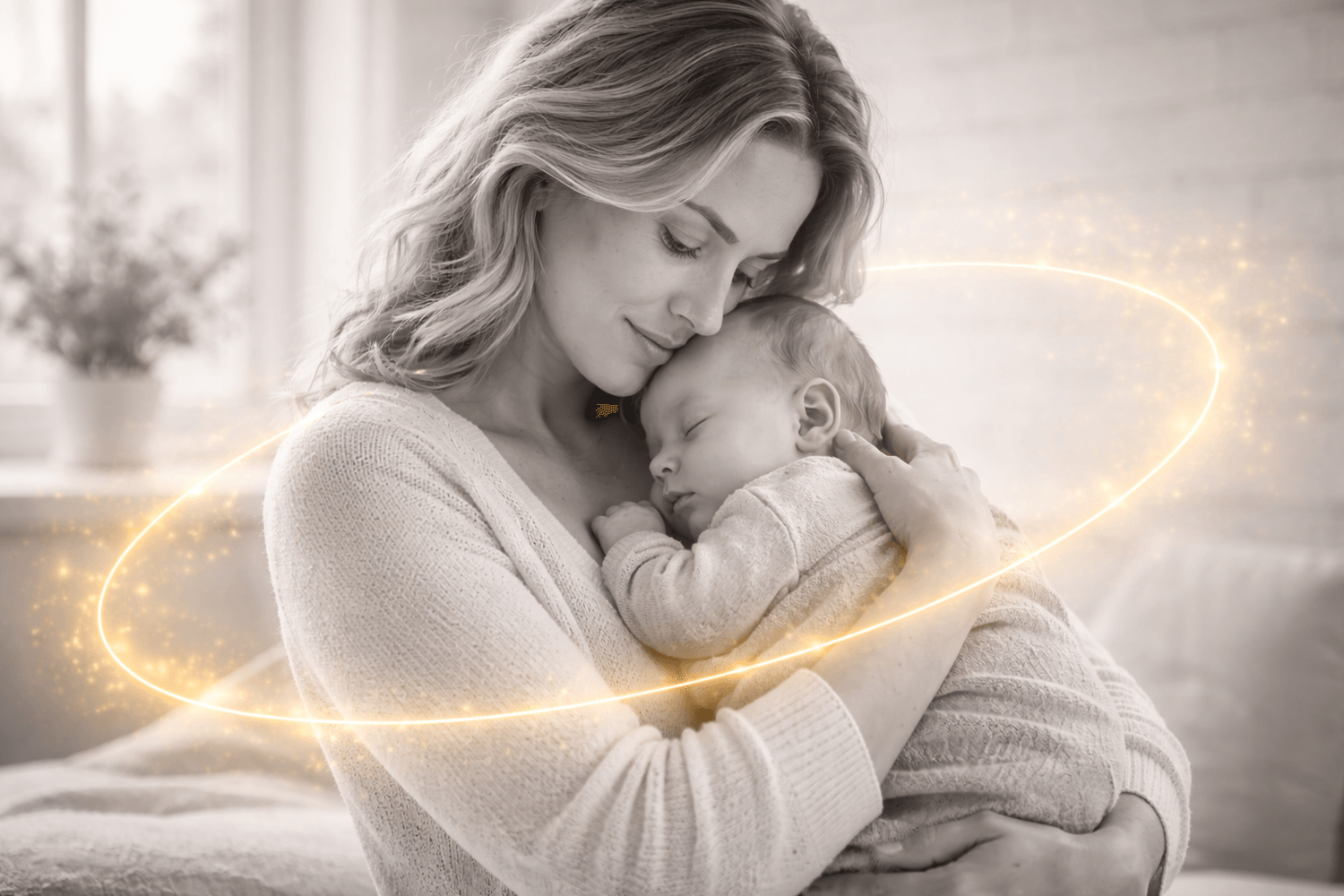
A mother's inner world is her child's first environment. Not the nursery, not the school, not the neighborhood. The inner world. The nervous system. The unresolved grief, the inherited fears, the places where her own formation left wounds that were never properly tended — all of it becomes the atmosphere the child breathes, long before the child has words for any of it.
This is the conversation I want to have. Not because it is easy, and not to place yet another impossible weight on the shoulders of mothers who are already carrying more than any one person was designed to carry alone. But because I believe, with everything in me, that the single most consequential thing any parent can do for their child is also the most quietly radical: to heal.
We are all carrying something
There is a version of the healing conversation that locates the wound in exceptional circumstances, in dramatic trauma, in obvious neglect, in experiences that are clearly and legibly harmful. This version is not wrong, but it is incomplete. Because what I have come to understand, through my own sustained healing work and through the years I have spent with parents and young people in my practice, is that we are all carrying something. Every one of us, without exception.
Our parents carried it too. And their parents before them. We inherit not only the love that was given to us but the unprocessed grief that was not. The emotions that were not permitted. The needs that were not safe to name. The survival mechanisms that were formed in response to circumstances that were nobody's fault and that shaped us nonetheless in the nervous system, in the body, in the unconscious architecture of what feels familiar and what feels threatening.
When we become parents, that inheritance does not stay quietly in the past. It arrives in the relationship. It shows up in the moment a child does something entirely ordinary and developmentally appropriate — spills milk, resists a transition, pushes a boundary, expresses an emotion at full volume — and the parent's response is disproportionate. Not because the parent is broken, but because something in that ordinary moment activated something that was already there, stored in the body long before this child existed.
The child becomes, in this way, a mirror. Not always a comfortable one. The hardest children to parent are almost always the ones who activate the deepest and most unprocessed material in the adult. And the temptation, in those moments, is to locate the problem in the child, their behavior, their temperament, their demands, rather than in what the child's behavior is surfacing in us.
Understanding this does not mean there is something wrong with us. It means we are human, shaped by experience, carrying what we were given and that we have the capacity to choose, consciously and often with difficulty, to stop passing it forward.
INSIGHTS WORTH SITTING WITH:
The child who will not comply is not presenting a problem to be solved. They are presenting a mirror and what it reflects is almost always something the adult has not yet looked at in themselves.
The most powerful regulatory tool a parent possesses is not their authority, their volume, or their consequences. It is the state of their own nervous system.
The difference between a bully and a leader is not temperament. It is what the adults in that child's life chose to do with the energy they were given.
The body keeps the score and the mother's body keeps the family's
There is something important to understand about how unprocessed experiences are held in us, because it explains why so much of the healing work cannot happen through thought alone. When something overwhelming occurs, especially in childhood, when the nervous system is still forming and the capacity to integrate difficult experiences is limited, the body goes into protective response. Fight, flight, freeze. And if the cycle is not allowed to complete, if the energy of that response is suppressed or overridden rather than discharged, it stays. It is stored in the tissue, in the nervous system, in the body's memory.
This is why a scent, a tone of voice, a particular quality of tension in a room can produce a response that feels wildly disproportionate to what is actually happening in the present moment. The reactivity is not coming from now. It is coming from then — from a moment, perhaps decades past, that was never fully metabolized. The nervous system cannot always distinguish between then and now. It responds to the present through the filter of what was never resolved.
What this means practically, for a mother navigating the ordinary chaos of family life, is that the moments that feel most out of control, when the response seems larger than the situation justifies, are almost never about the situation. They are invitations. Uncomfortable, inconvenient, sometimes alarming invitations to notice what is being activated, to get curious about it rather than overriding it, and to begin, gradually and gently, the work of completing what was left incomplete.
This is not work that happens all at once, and it is not work that is finished. It is practice. It is the repeated, patient turning of attention toward the body's signals, toward the tightening, the heat, the urge to flee or to control, not to perform the right response, but to develop the capacity for a response that comes from the presence rather than from the wound.
And crucially: this practice does not begin in the heated moment. It is built in the quieter ones. In the moments of reflection after a difficult interaction — what happened in my body just then? what was I telling myself? where did this come from? — a mother begins to develop a different relationship with her own interior experience. Not one of judgment and shame, but one of curiosity and compassion. And it is precisely this relationship with herself that she then becomes capable of offering to her child.
What the child is actually learning.
I want to be direct about something that is easy to intellectually understand but genuinely difficult to hold in its full weight: children do not merely hear us. They experience us. They feel the quality of our nervous system before they register our words. They absorb the emotional tone of an interaction, its openness or its contraction, its ease or its urgency, and they form meanings from it that we never explicitly taught and may never know they hold.
When a child grows up in the emotional atmosphere of a parent who is consistently overwhelmed, whose love is real but whose fear is louder, whose good intentions are wrapped in anxiety and control, that child is not simply witnessing stress. They are internalizing a story about themselves. About what it means to make a mistake. About whether their needs are safe to express. About whether love is something that stays constant or something that must be earned, maintained, and protected through perfect performance.
The child who feels they must get straight A's to keep a parent's emotional equilibrium is not simply an ambitious student. They are a child who has learned that love is conditional, not because the parent does not love them unconditionally, but because the parent's unprocessed fears have made the love feel conditional in practice. The child who never pushes back, who never expresses discomfort, who smooths every interaction into acceptability, that child has learned that their own experience is a burden, and has accommodated themselves out of their own interiority in order to maintain the relationship.
These patterns do not stay in childhood. They travel. They show up in adult relationships, in professional dynamics, in the intimate architecture of how a person understands themselves to be lovable, capable, worth advocating for. The child who was not given room to have a voice often cannot find it for decades. The child who learned that love required performance spends their adult life performing.
This is not about blame. No parent does this consciously. Most of the patterns are invisible to the parent who carries them precisely because they were invisible to the parents who passed them on. But once we can see them, we can no longer unsee them. And what we can see, we can begin to change, slowly, imperfectly, without demand for immediate results.

The myth of self-sacrifice
There is a belief about motherhood that runs so deep in most cultures that it barely registers as a belief at all. It feels simply like the truth: that a good mother puts herself last. That love, properly expressed, means constant availability, constant giving, the subordination of one's own needs to the needs of the child. That to tend to oneself is, in some essential way, to take something away from them.
This belief is not only false. It is harmful. Because the self-sacrifice it demands does not actually disappear; it is transferred. The child who grows up knowing, at some wordless level, that their existence depleted someone they love, carries that knowledge as weight. As guilt. As the sense that their needs are too large, that their presence costs something. The burden that the mother intended to spare the child becomes, through the very act of self-abnegation, the child's burden to carry.
The mother who tends to her own healing, who insists on her own presence and her own needs as legitimate and worthy of care, is not being selfish. She is modeling something her child desperately needs to witness: that a person can be whole and be in relationship. That love does not require self-erasure. That being present in one's own life, being connected, regulated, awake, is not indulgent. It is the most generous thing a mother can offer.
Because what we are ultimately passing to our children is not our sacrifice. It is our being. And the quality of what we pass depends entirely on the quality of what we have been willing to cultivate in ourselves.
Where healing begins
For any mother who is reading this and feeling the weight of it, who can see, perhaps for the first time with some clarity, the distance between where she is and where she wants to be, I want to say this directly: the distance does not need to be crossed all at once. It does not, in fact, need to be crossed at all in the way we usually think about crossing distances. Healing is not a destination. It is a direction. And taking one step in that direction is enough to begin changing the quality of what moves through the underground root system.
One honest conversation with a friend who truly listens. One morning walk that is genuinely for yourself. One moment of pausing, after a difficult interaction with your child, to ask with curiosity rather than judgment, what just happened in my body? One decision to seek support, from a therapist, a coach, a community, rather than continuing to carry alone what was never meant to be carried alone.
These are not small things dressed up as big ones. They are genuinely significant, because they represent a turning, from the direction of self-bypassing toward the direction of self-presence. And self-presence, over time and with practice, becomes the most powerful gift any parent can offer their child.
The mother tree does not produce resilience in her community through a single dramatic act. She does it through a thousand years of daily, invisible nourishment. Through being, consistently and deeply, what she is.
We are each someone's mother tree. The question is only how conscious we are of it.
The conversation that inspired this reflection is now live on The Potentiality Podcast. My guest, Ani Varbedian, licensed marriage and family therapist and founder of Intentional Family Therapy, brought extraordinary clinical depth, personal vulnerability, and genuine compassion to everything we explored together. I invite you to watch the full episode.
In Wholeness,
Dr. Alina Vehuni
Good Things Happen to Those on the List - Join us!
Subscribe to the newsletter and stay in the loop! By joining, you acknowledge that you'll receive our newsletter and can opt-out anytime hassle-free.
Created with ©systeme.io