



The Child Who Will Not Comply Is Often the One the World Needs Most
On strong-willed children, the parent's unprocessed patterns, and the difference between breaking a will and guiding one
I was a strong-willed child. I know what that phrase sounds like from the outside and I know what it felt like from the inside. I remember the friction, the sense of being too big for the containers that were offered to me, the way my will was met not with curiosity but with the need to subdue it. I did significant healing work as an adult to recover from what that dynamic cost me. And I raised two strong-willed sons, which gave me the other vantage point entirely, the one from which you understand, viscerally and without abstraction, how much it asks of a parent to meet that kind of child with the spaciousness they require rather than the control that feels instinctive.
I have also spent more than two decades in education, working alongside thousands of children and adolescents who carried this label. And I have come to understand through all of it - the personal and the professional, the child I was and the parent I became - that the label itself is almost always a misdirection. It describes the adult's experience of the child far more accurately than it describes the child.
This piece is about what is actually happening beneath that label and what becomes possible when we stop trying to solve it.
The label describes the adult, not the child
When a parent calls a child strong-willed, they are almost always describing a child who is difficult for them to handle. These are not the same thing. Some children genuinely possess an unusually strong sense of self, a refusal to be easily compliant, a persistence in advocating for their own needs and this, when it is real, is accurately named. But many of the children who receive this label are actually children in significant anxiety, children who may be highly sensitive and are expressing the full weight of what they feel in ways the adult around them does not know how to receive, or children whose impulse control is still very much in development and who need patience, not pathologizing.
The label "strong-willed" functions, in many households and many classrooms, as the name we give to children whose interior experience exceeds our capacity to hold it. This is a crucial distinction because when we locate the problem in the child, we stop asking the more important question, which is: what would it take for me, as the adult in this relationship, to become a big enough container for what this child is carrying?
That question is not comfortable. But it is the only one that leads anywhere useful.
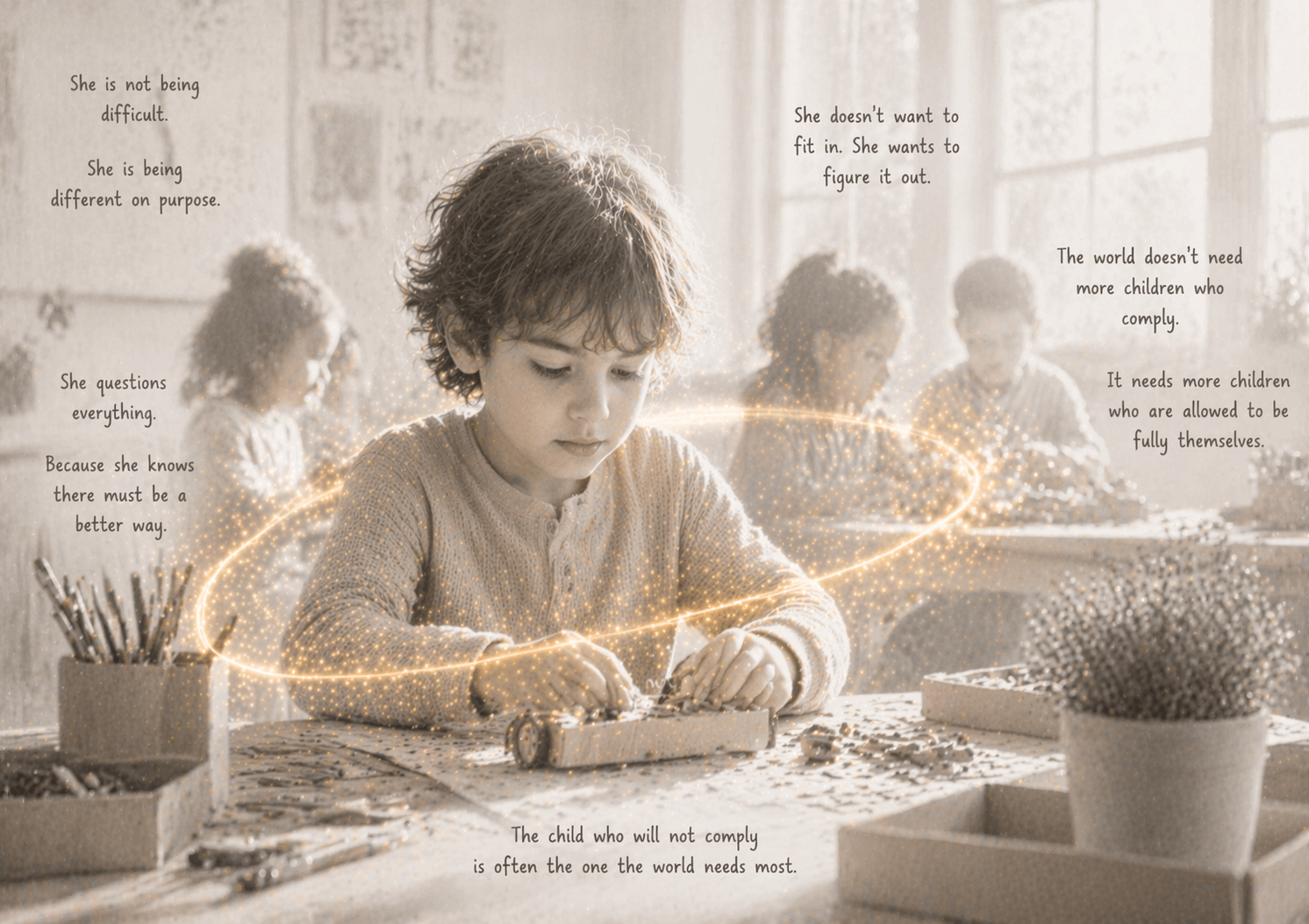
The child is holding up a mirror
There is a truth about parenting that most parents encounter sooner or later, usually in the form of a moment that surprises them with its intensity: having a child brings out your deepest attachment patterns. The ways you learned to give and receive love. The emotions you were permitted to feel and the ones you were taught to suppress. The survival mechanisms you developed in response to a childhood that asked more of you than you had the resources to manage.
Children do not replicate the experience we had with our own parents. They replicate the feelings. The parent who grew up in a household where emotions were not permitted, where needs were met with withdrawal or disapproval, where the child's interior life was consistently subordinated to the adult's comfort, that parent has built a nervous system organized around the suppression of precisely what their own child is now expressing freely. And when that child refuses to suppress, when they feel things loudly and without apology, the parent's entire system is triggered not by the child's behavior, but by the child's freedom.
This is what the "strong-willed child" so often reveals: not a child with a problem, but an adult confronting the unfinished business of their own formation. The child is not the mirror of who the parent fears they will become. The child is the mirror of what the parent was never allowed to be.
Understanding this does not make the moment easier. But it relocates the work. The question shifts from how do I manage this child to what is this child showing me that I have not yet been able to look at? And that shift from management to inquiry is the beginning of everything.
Power struggles are a sign that hierarchy has been lost.
In my years working with both educators and parents, I have observed one consistent pattern in the dynamics that exhaust adults the most: they have entered into a battle with the child. And the moment a power struggle begins, something essential has already been lost because parenting cannot happen from inside a battle. It can only happen from a position of calm authority that the child can, consciously or not, feel as safe.
This is not authority in the coercive sense. It is authority in the sense of being the most regulated person in the room. Of holding the space rather than joining the chaos. Of understanding that the child's escalation is communication rather than a provocation to be matched.
The biological reality is this: children regulate their own nervous systems through co-regulation with the adults around them. The most powerful tool a parent or educator possesses is not their volume, not their physical presence, not their capacity to enforce consequences. It is the state of their own nervous system. A calm, regulated adult is a physiological intervention. The child's system, which is scanning constantly for cues about whether the environment is safe, reads the adult's state before it reads any instruction or consequence the adult delivers. Calmness in the adult is not a passive quality. It is an active force and in moments of escalation, it may be the only force that actually works.
This means that the question in the most difficult moments is never what do I do about this child. It is how do I return to myself? How do I feel my body, slow my breath, drop back into the steadiness that makes me someone this child can co-regulate with? The answer is practiced, not improvised. It is built through repetition in the ordinary moments so that it is accessible in the extraordinary ones.
INSIGHTS WORTH SITTING WITH:
The child who will not comply is not presenting a problem to be solved. They are presenting a mirror and what it reflects is almost always something the adult has not yet looked at in themselves.
The most powerful regulatory tool a parent possesses is not their authority, their volume, or their consequences. It is the state of their own nervous system.
The difference between a bully and a leader is not temperament. It is what the adults in that child's life chose to do with the energy they were given.
The difference between breaking a will and guiding one
This is perhaps the question that matters most, and the one I carry most personally. What is the difference between suppressing a child's will and developing it? Between producing compliance and cultivating character?
The answer, I have come to believe, lies almost entirely in how we understand a child's resistance. Traditional approaches to parenting and discipline tend to treat resistance as the problem, as something to be overcome, reduced, trained out of the child until they can function within the structures the adult has decided are appropriate. This produces, in the best cases, obedient children. In the worst cases, it produces children whose will has been so thoroughly overridden that they lose access to their own sense of direction, their own judgment, their own capacity to know what they think and to trust it.
The alternative is not permissiveness. It is not the absence of boundaries or the abandonment of structure. It is something considerably more demanding: the willingness to treat the child's resistance as information. To ask, with genuine curiosity rather than judgment, what is this child trying to achieve? What need is underneath this behavior? What would it look like to honor the intelligence in this refusal while still holding the limit that is necessary?
This requires conversation. A real conversation in which the adult is genuinely open to hearing something they did not expect, and in which the child's perspective is treated as worth engaging with rather than simply overriding. In my own experience of raising two strong-willed sons, the moments in which I was willing to ask what they thought and to actually listen to the answer consistently produced something that surprised me: thoughtfulness, wisdom, consideration that I had not anticipated. Children, it turns out, often have extremely good ideas. We tend not to know this because we rarely ask in a way that communicates what we truly want to hear.
Guiding a strong will means keeping the child in relationship with their own values, their own developing sense of what matters and why, while teaching them that the way energy moves matters as much as the fact that it moves. The will itself is not the problem. The will, unguided and unsupported, becomes reactive. The will, met with curiosity and equipped with tools, becomes something else entirely.
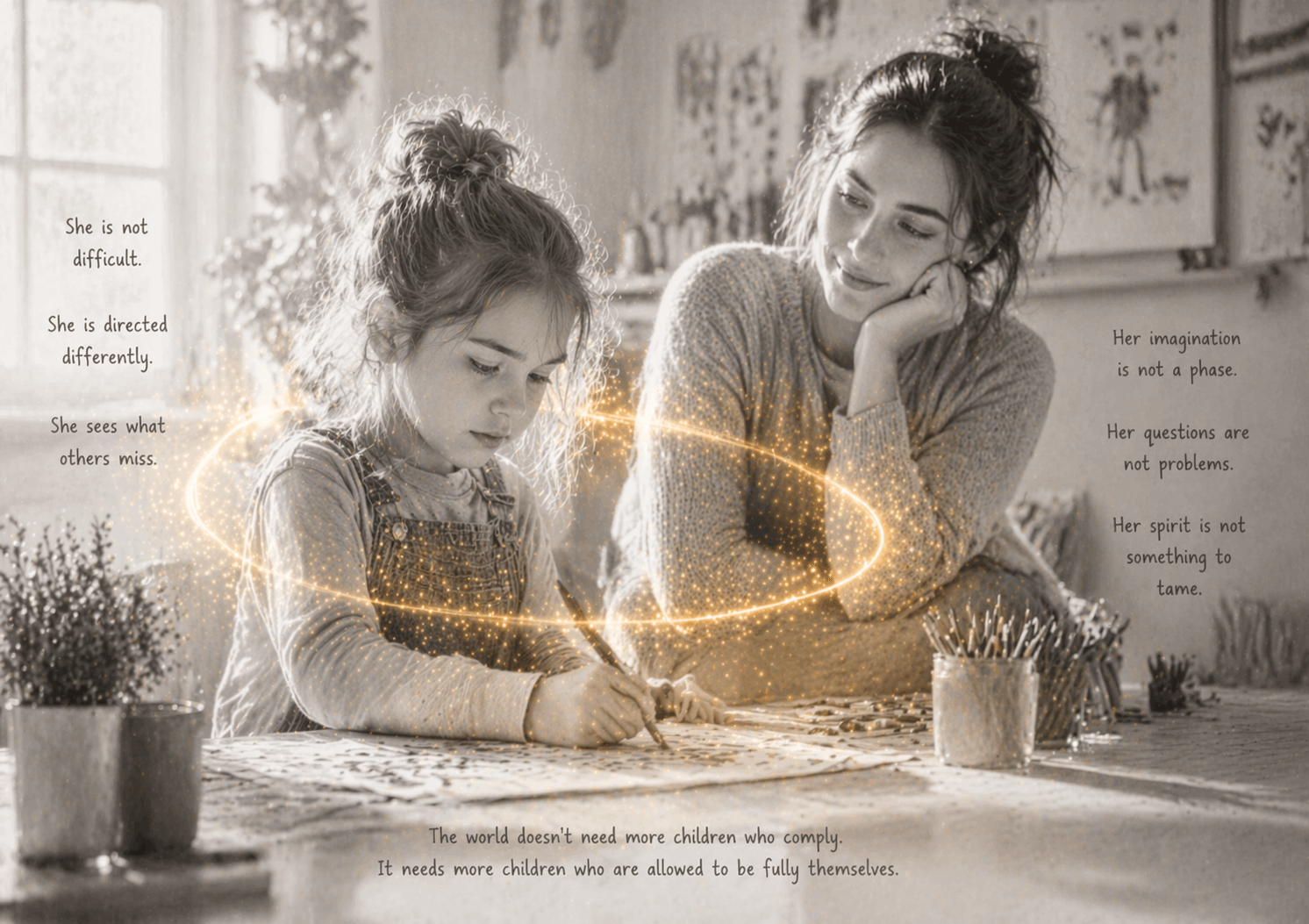
The bully and the leader share the same qualities
I want to name something directly, because I have watched it play out across more than two decades in education and I believe it is one of the most important things adults who work with strong-willed children can understand: the qualities that make a child difficult in a conventional classroom or a conventional family are almost identically the qualities that, properly developed, produce the people who change things.
The child who will not simply comply. Who asks why, and keeps asking after the adult has grown tired of answering. Who pushes boundaries not out of malice but out of a genuine need to understand where the edges are and why they are there. Who feels everything at full volume and communicates it without the restraint that adults have learned to perform. These children are often the creatives, the innovators, the ones who think at angles the more compliant children never explore. They are the future leaders, the artists, the architects of things that do not yet exist.
They are also the ones most at risk of becoming something else entirely if what they encounter, consistently, is not curiosity and guidance but judgment, suppression, and the relentless message that their nature is a problem to be corrected. The difference between the leader and the bully, in many cases, is not temperament. It is what the adults in that child's life did with the energy they were given.
In over twenty years of education, I can say unequivocally: anti-bullying curricula do not work. What works is giving strong-willed young people genuine leadership opportunities, contexts in which their energy can be channeled toward something meaningful rather than suppressed, in which the qualities that make them difficult in passive, compliance-oriented environments are recognized as assets and given room to develop. This is not a soft observation. It is what the evidence, and my own sustained experience, consistently shows.
The question for any parent or educator encountering a strong-willed child is not how do I manage this. It is whether I want to raise a bully or a leader and what I am willing to do differently to ensure the answer is the latter.
The conversation that inspired this reflection is now live on The Potentiality Podcast. My guest, Cornelia Dahinten - therapist, conscious parenting educator, and founder of Conscious Connections Consulting - brought extraordinary depth, clinical wisdom, and genuine compassion to everything we explored together. I invite you to watch the full episode.
In Wholeness,
Dr. Alina Vehuni
Good Things Happen to Those on the List - Join us!
Subscribe to the newsletter and stay in the loop! By joining, you acknowledge that you'll receive our newsletter and can opt-out anytime hassle-free.
Created with ©systeme.io