



When the Smoke Cleared, What Remained? From Crisis Response to Movement
On identity, crisis, and the leadership already living inside our young people
When the Eaton Fire tore through Altadena in January of 2025, the world watched from a safe distance and those of us who love someone in Los Angeles watched from an even more agonizing one. I was in Dubai when the calls began coming in, messages from family and friends asking if I was alright, and every time my phone lit up, I found myself in tears for the people I knew were standing in the ash of what used to be their ordinary lives.
We speak a great deal about survival in the aftermath of disaster. We count the living. We move people to shelters. We coordinate donations, organize food, restore power. And all of that is necessary, urgent, and right. But there is a quieter kind of loss that unfolds in the shadow of survival. The kind that does not make the evening news, one that families in crisis rarely have the language or the bandwidth to name. And it is the loss of self.
I had the privilege of interviewing Lauren Sandidge, founder of Altadena Girls and one of the most thoughtful voices I have encountered in the space where community, mental health, and young people's lives converge. What she shared with me opened something that I have been carrying in my work for years, but rarely heard spoken so plainly.
The bedroom is not just a room.
Lauren told me about her daughter Avery, fourteen years old at the time the fires broke out, who sat with her own helplessness and then, rather than be consumed by it, channeled it into action. What Avery noticed, with the particular clarity that adolescents so often possess when adults are too overwhelmed to see, was that no one was specifically looking after the mental health of teenage girls. Not because it did not matter, but because the families around her were, understandably, in survival mode.
And survival mode, as any of us who work with young people know, is not the same as recovery. Survival mode keeps the body alive. Recovery asks what it means to feel like yourself again.
Avery understood this instinctively. She thought about what her friends were truly losing. The records and the posters. The clothes they had chosen carefully because they said something about who they were becoming. The books dog-eared at meaningful passages. The small, accumulated artifacts of an adolescent identity still very much in formation.
As Lauren put it so beautifully: teenage girls collect things as a reflection of who they are. And when those things are gone, something more than property is lost. What is lost is the mirror - the visible, touchable evidence of a self that is still being discovered.
This is not a small thing. This is the whole thing.
In my work through Wholeness Education, I return again and again to the idea that what we fail to see in young people, we fail to support, and what goes unsupported does not simply disappear. It goes underground. It becomes the unnamed ache that surfaces years later as disconnection, anxiety, a persistent sense of not quite belonging to one's own life.
When we look at a teenage girl who has lost her home and ask only whether she is physically safe, we are asking only half the question. The other half is Does she feel like herself? Does she have the space to grieve not just what she lost, but who she was becoming inside what she lost? and it requires a different kind of attention. It requires adults who understand that identity development is not a luxury of stable times. It is the essential work of adolescence, and crisis does not pause it. Crisis accelerates it, complicates it, and in the absence of support, can fracture it in ways that take years to repair.
This is what Avery saw. This is what she could not simply sit still about.
INSIGHTS WORTH SITTING WITH:
Crisis takes away more than what's visible.
What goes unseen in young people does not disappear. It goes underground.
Leadership in young people emerges when it is recognized and trusted.
What leadership looks like before we recognize it.
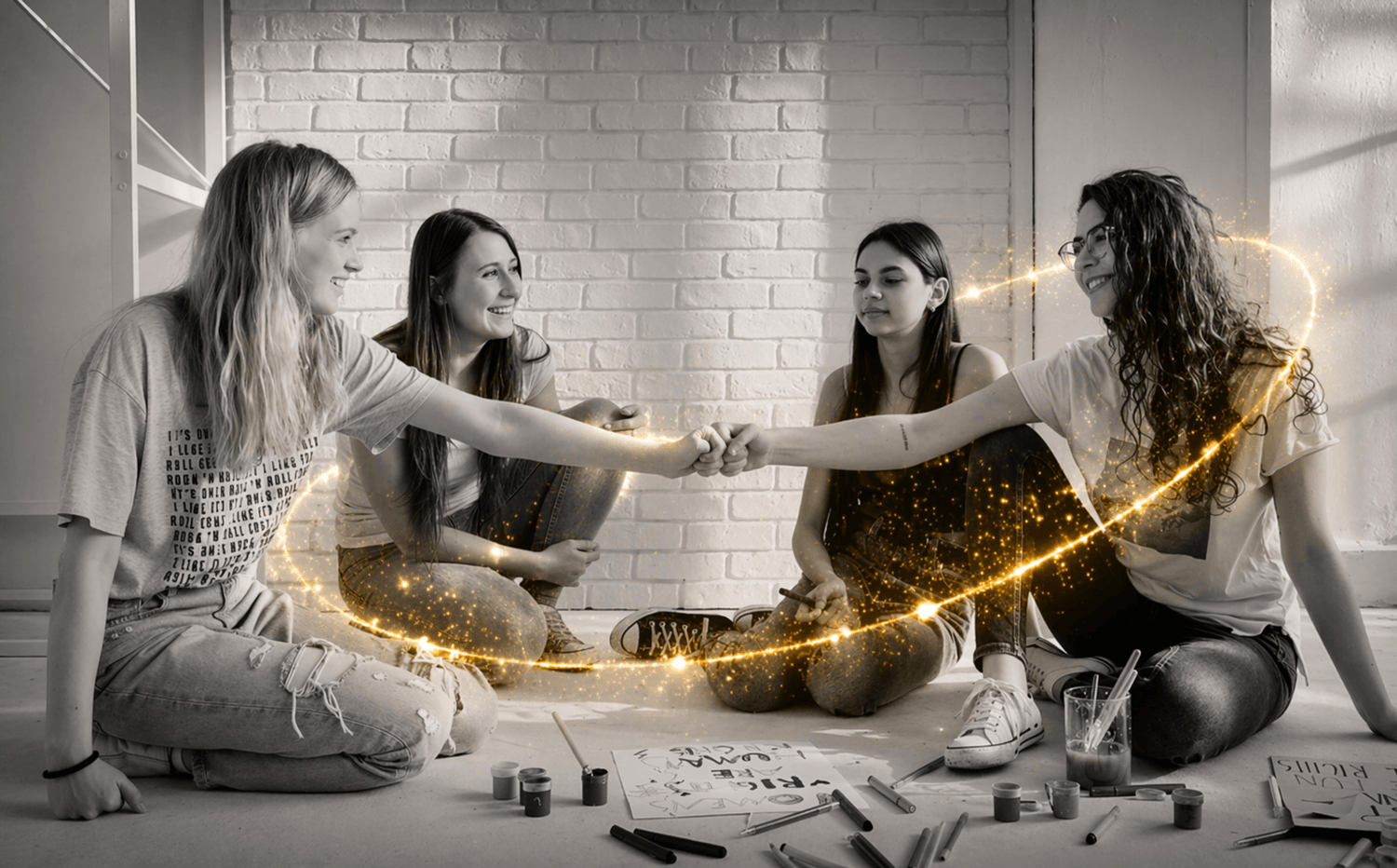
I find myself returning to the image of a fourteen-year-old girl, evacuated from her home, surrounded by the fear and uncertainty of people she loves, choosing not to collapse inward but to turn outward to ask, who is not being seen here, and what can I do about it?
Lauren has spent years working to raise a daughter who knows her voice matters, who has been told consistently that her perspective is not only welcome but necessary. And this is what that investment looked like in practice: not obedience, not compliance, but initiative. A girl who felt strongly, acted quickly, and had the determination to push something into being that did not exist before she imagined it.
Altadena Girls is now a growing nonprofit with a physical space, community partnerships, and a mission that has expanded well beyond a crisis response. But it began, as all genuine movements do, with one person who felt the gap between what was and what should be and could not leave that gap unfilled.
I believe every young person carries this capacity. Not all of them will found a nonprofit at fourteen. But all of them are capable of seeing what adults miss, of caring more than they are given credit for, and of acting in ways that are meaningful when they are given the structure, the permission, and the encouragement to do so. The question is never whether the leadership is there. The question is whether we, as the adults in their lives, have created the conditions for it to emerge.
What the smoke leaves behind
There is a question I close every episode of Potentiality with: a question about what becomes possible for all of us, collectively, when young people are fully supported in developing their inner lives. Talking with Lauren, I found myself sitting inside a living answer to that question.
What becomes possible is a fourteen-year-old girl who turns her fear into a movement. What becomes possible is a community of girls who feel seen in their specific, intimate grief of losing the small things that were quietly telling them who they were. What becomes possible is recovery that goes deeper than survival, that reaches into the places where identity lives and says: you are not lost, even if everything around you is.
We talk often in education and in parenting about preparing young people for the future. But perhaps the more essential preparation is the one that gives them access to themselves - to their own inner architecture, their own capacity for clarity and courage and care, so that when the world asks something of them, they have something whole to offer.
Avery had something whole to offer. And the world around her is different because of it.
The conversation that inspired this reflection is now live on The Potentiality Podcast. My guest, Lauren Sandidge, mental health advocate, community leader, and founder of Altadena Girls, brought extraordinary vulnerability and clarity to everything we explored together. I invite you to watch the full episode and carry the learning into your own practice.
In Wholeness,
Dr. Alina Vehuni
Good Things Happen to Those on the List - Join us!
Subscribe to the newsletter and stay in the loop! By joining, you acknowledge that you'll receive our newsletter and can opt-out anytime hassle-free.
Created with ©systeme.io