

The Vehuni Inheritance - The Legacy of the Dignified Human
In memory of Maria and Tovmas Vehuni and of all that traveled forward through them
There is hardly an Armenian family that was not impacted or rather fully altered by the atrocities of 1915. Our stories are deeply personal and uniquely tragic, our post-genocide life trajectories vastly diverse, and yet our collective identity has become the same: we are all proud descendants of survivors of the Armenian Genocide. And we all carry a tremendous amount of generational trauma in our lineage that is now ours to heal, or to pass on.
Each year on April 24, we come together to tell our truth, the truth our grandparents and great-grandparents lived, in order to make our stories known, to demand justice, and to prevent future crimes against humanity. This year, I want to tell you about the two people whose survival made my life possible.
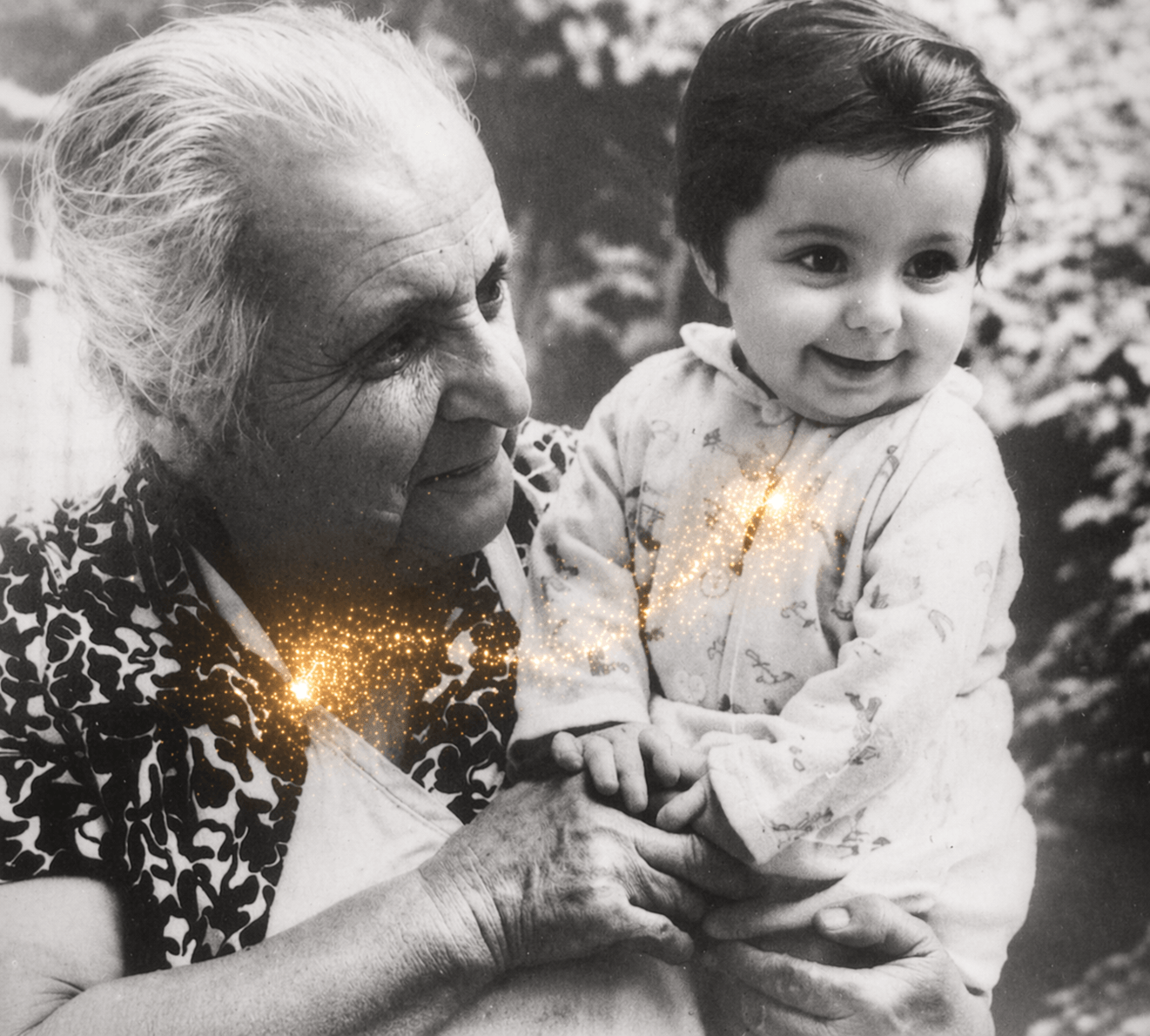
My great-grandmother's name was Maria (on the photo above), though everyone who loved her called her Maroos. In 1915, she was a fifteen-year-old girl living in a small village in Nakhchivan when the Ottoman Turks arrived and her entire family was massacred before her eyes. At the mercy of her neighbors, by some miracle, she survived. After running for miles, her neighbors pushed her into the river Aras and helped her swim across from what was then geographic Armenia into Iran. She arrived on the other side with no family, no money, no language adequate to what she had just witnessed, and the full weight of survival pressing down on a body that had never been built to carry it. With no one and nothing, her only path forward was marriage, and she married a forty year old man. In that family, my grandfather, Azat Vehuni (on the photo below with my mom), and his younger brother were born.
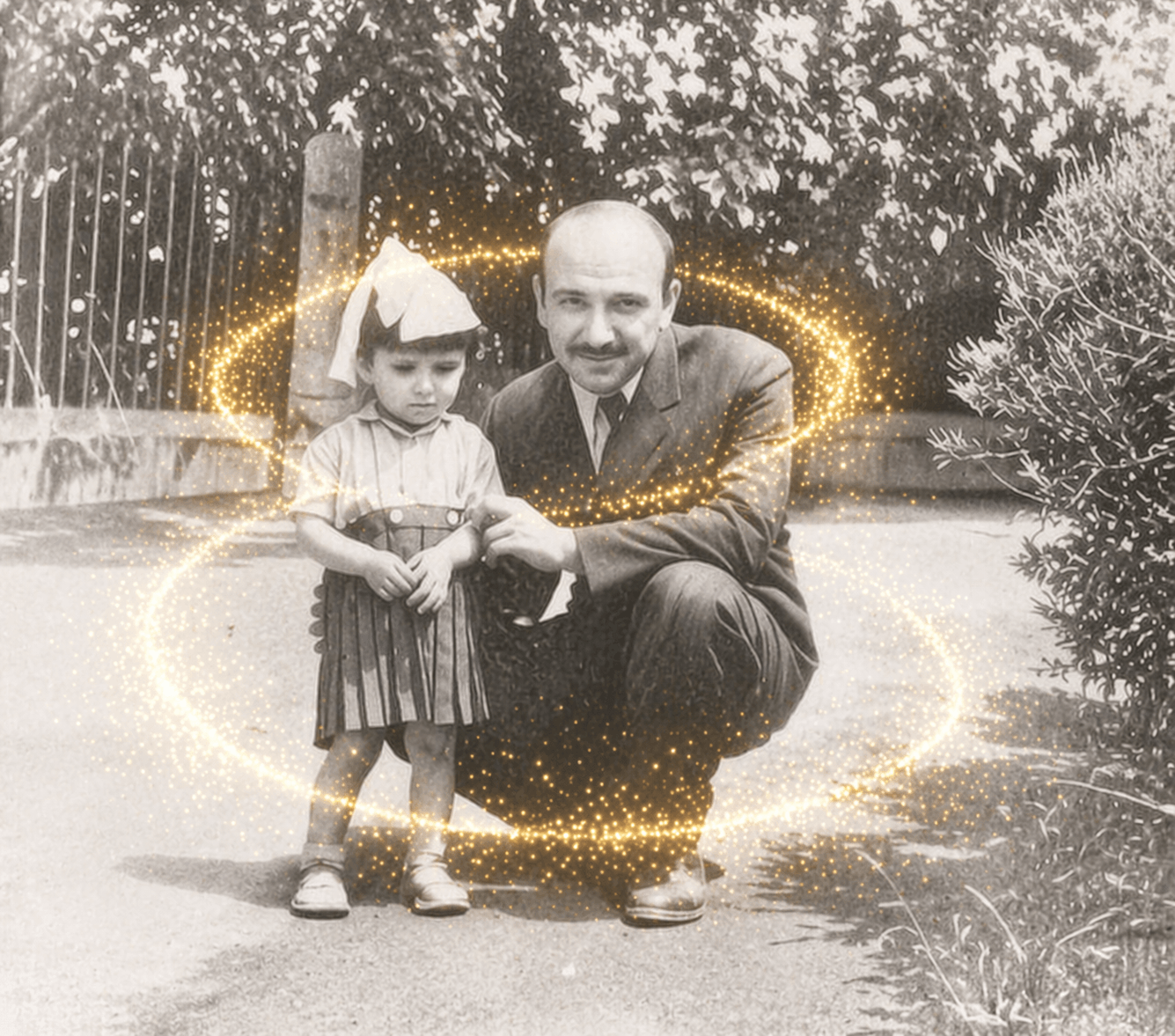
My great-grandfather, Tovmas Vehuni, was a man of an entirely different world, though the darkness that found him was the same. He lived in Diyarbakır, the city our ancestral memory knows as Tigranakert, where he had devoted himself wholly to the examined life: a lawyer, philosopher, scientist, poet, and clarinet player whose hands understood both precision and beauty. He was known among the city's intellectuals, respected in its courts, recognized as someone whose mind and whose presence carried the particular luminosity of a human being who has cultivated every dimension of himself with equal devotion. He was, in the truest sense, a whole person. And in 1915, that wholeness made him a target.
Because the genocide did not begin with ordinary people. It began with the thinkers, those whose inner lives were most fully developed, whose voices carried the farthest, whose very existence was a testament to what Armenian civilization had built over centuries. Tovmas was arrested alongside other prominent Armenian intellectuals, taken to a remote place, and subjected to tortures I will not dress in careful language. He was a lawyer and philosopher brought to his knees in the dark. Among everything taken from him there, they took his sight. He emerged from that place blind. And yet by some grace too fragile and too sovereign to explain, he escaped, found his way onto a single boat, crossed into Iran, and arrived on the other side alive, sightless, and carrying within him what could never be taken: the man he had cultivated himself into.
He made his way to Tabriz, where he lived for some years in the specific solitude of a displaced man, the grief of someone separated not only from his home but from the life his mind had been built for. And then, as sometimes happens in the wake of catastrophe, two losses found each other. He was introduced to a young Armenian woman who had arrived by her own harrowing road, Maroos from Nakhchivan, alone in a foreign country, the last living remnant of a world destroyed around her. They recognized each other the way survivors do, not with ease, but with the deep, wordless understanding of those who have seen the same darkness and chosen, nonetheless, to keep going. They married. They built what they could. They became, for each other, the only home either of them had left.
Tovmas could no longer see, so Maroos became his eyes. She wrote his letters. She recorded his thoughts. She sat beside him through the nights and put into words what his mind continued, ceaselessly, to produce, because even in blindness, even in exile, Tovmas never stopped thinking. My great-grandmother remembered that people still came to him with their hardest problems, that he would listen with the full force of that vast interior life and offer something no one else could. And she shared that he would wake her in the middle of the night and say, "I have been thinking. I understand now how to solve that problem and help the person. Write it down before we forget."
He never stopped. The darkness they placed him in could not touch the light he carried inside.
He died young, around fifty, leaving behind two boys of ten and twelve who had inherited something essential from him, that quality of mind, that devotion to knowledge and meaning, and who would eventually return to a reconstituted Armenia as respected scientists in their fields. He did not live to see it. But it came from him.
INSIGHTS WORTH SITTING WITH:
What survives through generations is not just trauma, but also purpose waiting to be remembered.
Wholeness is not something we create. It is something we are entrusted to protect.
The work we feel called to do is often older than us. It is lineage finding its voice again.
Maroos lived longer and built something of her own magnitude. After the Second World War, during the first wave of repatriation in 1946, she moved with her sons and daughter-in-law to Soviet Yerevan, where together with a group of fellow repatriates they built a small neighborhood right in the heart of the city, on Abovian Street, modest two-story buildings, structurally sound, still standing today, still inhabited by the generations of the families who built them. Maroos had no professional training, but she had something rarer: a quality of presence so loving that the community organized itself around her naturally. She was called to receive the first breath of newborns and to hold the hand of neighbors taking their last. She was the one summoned in crisis and in celebration alike. Everyone loved her. Even after her death, when the conversation turned to the power of a resilient and loving spirit, people would say simply, just like Maroos bubboh, and no further explanation was needed. Everyone knew exactly the depth of human character being discussed.
I was eight when she left us and I remember little (Maroos and I on the photo below). But I remember with complete clarity how I felt sitting on her lap, the quality of love in the air around her, so palpable and so generous that everyone who entered it would naturally become a more open version of themselves. And I remember the deep sorrow in her eyes, a grief she had never been fully able to process, for the life lost, and for the life lived without her loved ones. The only family she ever found again were the ones she built herself.
And this, heartbreakingly, is the destiny of most Armenian families who endured not only the loss of life, but the loss of an entire world of belonging. 1.5 million Armenians lost their lives. Those who lived lost their loved ones, their language, their land, their way of being in the world. Today's Armenia accounts for only 3 million people, while the Armenian diaspora around the world is three times larger, a nation scattered by catastrophe, still gathering itself across generations.
Our lives are largely shaped by our history. My family's life, and my own life even as the fourth generation, was shaped by events that happened over a century ago. And yet something moved through the ones who crossed rivers in the night, who found each other in foreign cities, who built families from the ruins of everything, something that could not be arrested or tortured into blindness. A quality of mind. A quality of heart. A refusal to let devastation be the final word.
I carry his last name. Vehuni, from the Armenian veh, means elevated, dignified, grand. For most of my life I understood this as identity. Standing here now, four generations later, I understand it as a calling and a responsibility. Because I have spent my life building something whose entire foundation rests on a single conviction: that the inner life of a human being is sacred, that wholeness is not a privilege but a birthright, that every child who comes into this world deserves to be seen and protected in the full depth of who they are. What writing this has made undeniable is that this conviction did not begin with me. It began with a man in Diyarbakır who was persecuted precisely because he embodied it.
Tovmas was imprisoned for being whole. And I am giving my life to making sure that wholeness, in every child, in every family, in every generation that follows, is never again what puts a life at risk, but what saves it.
The lineage did not break. It deepened.
To my great-grandmother Maroos, whose lap was the first place I experienced what unconditional love actually feels like, I see you.
To my great-grandfather Tovmas, whose name I carry and whose devotion to the wholeness of the human being I now understand as my inheritance, I hear you. I hear the call that survived imprisonment, blindness, exile, and a life lived far from everything you loved. I have been answering it my entire life without knowing its origin. Now I know: it is the call to protect what they tried to destroy in you, to build a world where no child is ever diminished for the fullness of who they are, where the life of the mind and the life of the heart are not liabilities but the coherent foundation of a dignified human existence, and the birthright of every child who comes into this world.
We have not forgotten. We never will. And I write this because it is not your pain that continues to live on through us, it is your legacy. The legacy of the dignified human. It lives on in every mind that refuses to stop thinking in the dark, in every heart that chooses love after devastation, and in every generation of the Vehuni lineage that carries your name forward - elevated, dignified, grand - into a world that needs what you gave us, now more than ever.
I am inviting you to ask yourself what has been passed forward through your own lineage, what quality of being, what refusal, what form of love survived the losses in your own family's story and arrived, transformed, in you. For it is by understanding what we have inherited that we can become conscious of what we are choosing to pass on. And it is by living a life worthy of those who came before us that we, in our turn, become the ancestors our descendants will one day speak of with reverence.
What is your story? In the words of Tovmas, "Write it down before we forget."
In Wholeness,
Dr. Alina Vehuni
Good Things Happen to Those on the List - Join us!
Subscribe to the newsletter and stay in the loop! By joining, you acknowledge that you'll receive our newsletter and can opt-out anytime hassle-free.
Created with ©systeme.io