



What Children Are Learning When We Think We're Just Doing Homework
On emotional tone, integrated living, and the invisible curriculum of every ordinary moment
There is a belief so quietly embedded in the way most families approach education that it rarely gets examined and it is this: that learning is something that happens somewhere else. At school. In a classroom. Within a structure designed by someone other than the child, in a building the child leaves every afternoon and re-enters every morning, having somehow, presumably, been changed by what occurred inside it.
This belief shapes everything. It shapes how parents understand their role. It shapes how children understand their own capacity. And it shapes, in ways that take years to fully surface, how young people come to feel about themselves as thinkers, as learners, as people who are or are not capable of growth.
I want to examine this belief and what becomes possible when we release it.
The fragmentation underneath
In my years of work as an educator, a school leader, and now through Wholeness Education, I have come to understand that most of what troubles young people - the disconnection, the disengagement, the quiet erosion of curiosity that so many families witness across the school years is not primarily an academic problem. It is a problem of fragmentation.
Internal fragmentation. A self that is divided from its own experience, that has learned to perform understanding rather than inhabit it, that sits in a classroom or at a kitchen table while some essential part of itself remains elsewhere, anxious, defended, waiting for the moment to be over.
We speak about learning gaps in education as though they are gaps in content. But more often, they are gaps in integration - the lived, embodied sense that what is being learned has something to do with who I am and what my life actually is. When that connection is absent, information may be retained long enough to pass a test, but it does not change the child. It does not become part of how they think, how they see, how they move through the world.
Integrated learning, learning that is whole, requires a different kind of attention. It requires that the brain and the body be in genuine communication with each other, that the child be sufficiently present to actually receive what the experience is offering, and that the adults facilitating that experience understand that their own inner state is not incidental to the process. It is the process.
The parent's role that most parents have never been told about
One of the most consequential reframes available to any parent is this: you are already a facilitator of learning. You have always been. The question is only whether you are facilitating consciously or by default.
When parents think of themselves as supporters of school, as people who ensure homework gets done, who drive to tutoring and sign permission slips and show up to conferences, they position themselves as adjacent to their child's education. Helpful, but secondary. The real learning, in this framing, happens somewhere else.
But consider what is actually happening in the hours a child spends at home. Consider the texture of a Tuesday evening: dinner, homework, whatever conversation unfolds or doesn't, the way a parent responds when a child is frustrated, the emotional quality of the space in which the child is asked to sit down and think. All of that is learning. Not metaphorically - literally. The brain is forming associations. Attitudes are being shaped. Beliefs about what it means to struggle, to not know, to try again, to ask for help, to be seen in a moment of confusion, all of it is being written in the nervous system of a child who has no idea it is happening.
This is the invisible curriculum. And it is more formative than any syllabus.
The parent who owns their role as a facilitator does not need to know every method being taught at school. They do not need to have answers. What they need is the willingness to be present, to pace themselves honestly within whatever time and energy they actually have, and to create the conditions in which the child feels safe enough to genuinely engage, rather than simply comply, or shut down, or perform a version of learning that leaves the real self completely untouched.

Emotional tone: the lesson before the lesson
Every adult who spends significant time with children carries an emotional tone. It is not optional. It precedes every word we speak, every instruction we give, every moment of facilitation we offer. Children feel it in the body before they process it in the mind. And the nervous system, which is always scanning for safety, responds to that tone before the child has any conscious awareness that a response is happening.
This is not a small matter. This is, in many ways, the whole matter.
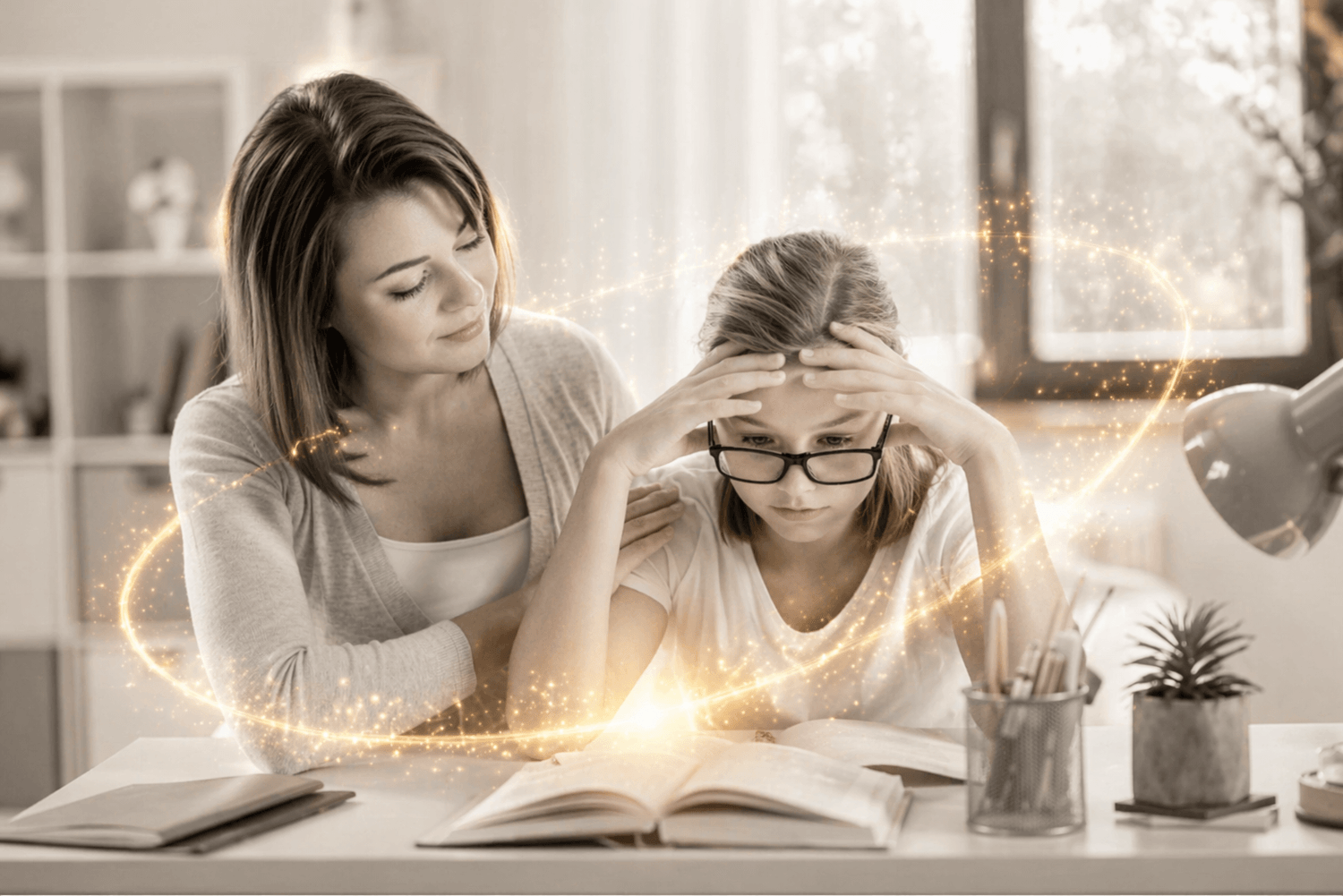
When a parent sits down to help a child with homework while internally depleted, rushed, or carrying unresolved frustration from the day, that emotional tone becomes the first thing the child learns from the interaction. Not the math problem. Not the vocabulary word. But the felt sense that this moment is dangerous, that a mistake here will cost something, that the adult beside them is not fully available, that the safest response is to hurry, to guess, to produce an answer quickly enough that the tension in the room dissipates.
The child in this environment may complete the assignment. The product may be correct. But in the deeper architecture of their inner life, something else has been written: that learning is something to survive, that confusion signals inadequacy, and that in moments of not-knowing, they are somehow - in a way they cannot yet name - less loved.
Contrast this with the child whose parent arrives at the same moment with a different internal orientation. Still limited in time, still imperfect, still human in every ordinary way, but settled enough to communicate through their presence that this moment is safe. That mistakes are expected and workable. That the child's process matters more than the product, and that whatever does not get finished tonight will be addressed tomorrow, by the teacher, by the next attempt, by the simple fact that learning does not end at bedtime.
That child is learning something entirely different. They are learning that curiosity is welcomed. That their confusion is not a verdict. That they are held, not just when they succeed, but in the mess and the middle of the not-yet-knowing. They are learning, in the most foundational sense, that they are loved while learning.
These two experiences do not stay at the kitchen table. They travel. They become the internal architecture from which a child approaches every future challenge, every unfamiliar idea, every moment that asks them to be uncertain in front of another person. The emotional tone of a single Tuesday evening is not the whole story, but it is a chapter, and chapters accumulate.
INSIGHTS WORTH SITTING WITH:
Learning is not located somewhere. It is lived in the moment.
The parent’s and teacher's inner state is the invisible curriculum.
Real learning requires integration, not performance.
What embodiment has to do with any of this
There is another dimension of integrated learning that formal education has long undervalued, and that parents rarely think to offer deliberately: the body itself as an instrument of knowing.
Children do not learn only through language and logical sequence. They learn through movement, through sensory experience, through the act of making something with their hands. They learn through song because rhythm and melody are among the most powerful encoding mechanisms the brain possesses. They learn through drawing because the connection between eye and hand and internal experience creates a form of integration that verbal explanation cannot replicate. They learn through the simple act of jumping, of bouncing, of feeling their own heartbeat, which has the extraordinary effect of returning them to the present moment at precisely the times when anxiety has pulled them out of it.
When a child is struggling, when frustration is building, when the material is not landing, when the nervous system has begun to shift from engaged to defended, the instinct of most adults is to push through. To redirect attention back to the task. To insist on stillness and focus as the conditions for learning.
But the body already knows what the adult is trying to enforce: that something needs to shift before genuine learning can resume. A moment of movement, of creative expression, of physical discharge and return, is not a departure from learning. It is a restoration of the conditions in which learning becomes possible again.
This is what integrated education actually looks like in practice. Not a curriculum delivered to a passive recipient, but a dynamic, responsive, embodied process in which the child's whole self - mind, body, emotion, history, present moment - is welcomed into the room.
The coherence we cannot fake, and the gift it becomes
Perhaps the most important thing I want to say and the thing I return to most consistently in my own work is that the inner development of the adult is not separate from the outer development of the child. They are in direct relationship. The regulation, the awareness, the capacity for presence that a parent or teacher cultivates in themselves does not stay private. It becomes the emotional environment in which children grow.
We cannot offer a child more settledness than we ourselves have access to. We cannot model curiosity we have stopped feeling, or patience we have never practiced, or the kind of generous, open attention that communicates: you matter more than the outcome of this moment. These things cannot be performed indefinitely. They have to be real. And they become real only through the ongoing, often unglamorous work of tending to our own inner lives.
This is the work that Wholeness Education is built around. Not the optimization of children's performance, but the cultivation of wholeness - in adults first, and through adults, in the young people they love and teach and shape.
Because children do not ultimately learn from our instructions. They learn from our being. They learn from watching how we hold difficulty, how we recover, how we remain present when presence is hard. They learn from the quality of attention we bring to an ordinary Tuesday evening, whether it is the kind of attention that says let's get through this or the kind that says let's figure this out together.
The difference between those two sentences is the difference between a curriculum of survival and a curriculum of wholeness.
The conversation that inspired this reflection is now live on The Potentiality Podcast. My guest, Ashley Blanco - artist, educator, and visionary behind Educate to Invigorate - brought the kind of grounded clarity to these ideas that I know will stay with you. I invite you to watch the full episode and carry it into your own practice.
In Wholeness,
Dr. Alina Vehuni
Good Things Happen to Those on the List - Join us!
Subscribe to the newsletter and stay in the loop! By joining, you acknowledge that you'll receive our newsletter and can opt-out anytime hassle-free.
Created with ©systeme.io